


Flappy VPN — Stay Connected
KAWASHARK
Flappy VPN — Stay Connected is a small Android app in the Comics category, developed by KAWASHARK. I approached it with a simple question: does its stripped-back presentation make it easier for people with different needs and everyday circumstances to use? The answer is mixed. Its uncomplicated identity can feel approachable, but the limited information around the experience also means users may have to make important decisions without much guidance.
The app is free and carries an Everyone age rating, which makes it easy to consider for a broad audience. It has passed the early stage of public availability with over ten thousand installs, and version 1.1.0 is the current release. It runs on Android 7.0 or later, so compatibility reaches older devices as well as newer phones. That matters for people who keep an older handset because replacing it is expensive, unnecessary, or difficult.
How the simple presentation affects readability and navigation
The clearest thing about Flappy VPN is its deliberately narrow identity. The store summary says it keeps things simple, and that promise sets the right expectation: this is not presented as a large, feature-heavy security suite. For someone who becomes overwhelmed by crowded dashboards, long setup flows, or too many technical choices, a restrained app can be less tiring to approach.
That simplicity is useful for first-time VPN users who mainly want to understand what the app is for without studying networking terminology. I would be more comfortable recommending it to a person who prefers one obvious task at a time than to somebody who wants detailed control over every connection setting. A short path from opening the app to understanding its purpose is especially helpful when attention is limited or when the phone is being used under pressure.
At the same time, simple does not automatically mean accessible. Readability depends on more than having few screens. People may need clear labels, strong visual hierarchy, predictable navigation, and enough explanation to understand what a control will do. A minimal interface can become confusing if it relies on symbols, vague wording, or visual distinctions that are hard to notice.
Related News

Why WhatsApp Messenger Still Makes Everyday Communication Feel Easy

Jurassic World: The Game Is the Better Dino Tycoon for Strategic Players

Threads in Real Life: Who Should Join, Lurk, or Leave

How SHEIN Turned Shopping Into an Endless Content Feed

How to Make Fortnite Feel Smarter on Mobile

Should You Switch to Microsoft Outlook on Mobile?
My practical advice is to read each visible control carefully before proceeding rather than tapping the most prominent button automatically. If you are helping a family member use the app, explain the purpose of the screen in ordinary language first. That small step reduces the chance that a user mistakes a connection action for a settings action or assumes that an unclear status message means something it does not.
The app’s name may also create an unusual expectation. “Flappy” sounds playful, while “VPN” suggests a utility concerned with network privacy or routing. That contrast could be memorable, but it may not immediately communicate the seriousness of the task to someone unfamiliar with VPNs. I would introduce it plainly: this is an app intended to support a VPN-style connection experience, not a game despite the playful wording.
Why a low-clutter approach can help some users
For users with cognitive disabilities, anxiety around technical tools, or limited experience with Android settings, fewer choices can reduce decision fatigue. A person who only needs a straightforward connection workflow may not want server lists, protocol terminology, usage charts, or account prompts competing for attention. In that situation, the app’s modest positioning is a strength.
Gallery
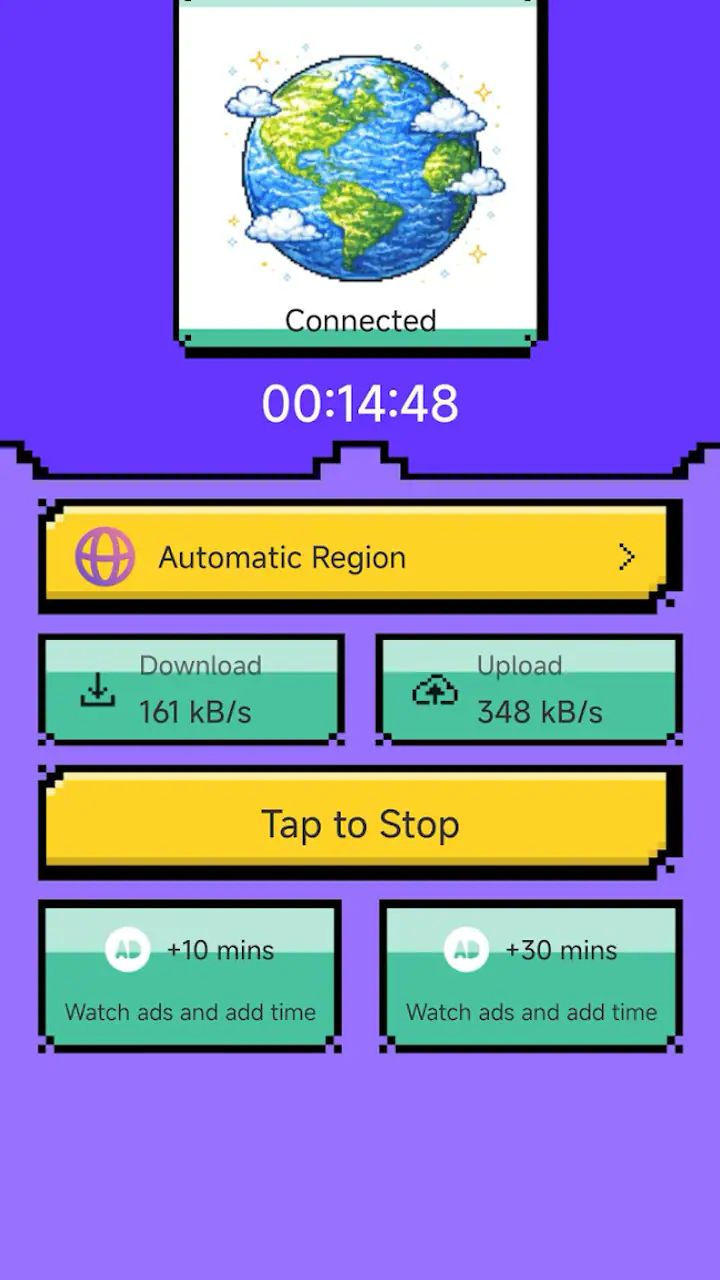
There is also a benefit for people using small screens or older phones. Dense interfaces often force users to zoom, scroll sideways, or carefully target small controls. A focused design has the potential to avoid those problems, although the actual benefit still depends on how the controls are arranged and labeled on the individual device.
I would not assume that a clean appearance solves every reading challenge. Users with low vision may still need larger text, strong contrast, or Android’s own display adjustments. Someone with dyslexia may benefit from short instructions, but only if the wording is direct and the layout does not hide essential information. The safest approach is to test the first-run experience slowly and keep the system’s accessibility tools available.
Motor, sensory, and attention-related considerations
VPN apps are often used with a quick tap, but that does not mean every user can perform that tap easily. People with tremors, reduced dexterity, temporary injuries, or one-handed use may struggle with small targets or controls placed near the edge of a screen. Flappy VPN is most comfortable for these users when its primary action is visually distinct and does not require a sequence of precise gestures.
I would use it in portrait mode with the phone held securely, especially if I were switching networks while walking, carrying something, or commuting. A user with limited hand control should avoid treating the app as a tool to operate hurriedly. Pause, confirm the intended action, and use Android’s larger display or magnification options if needed. Those system adjustments can make a bigger difference than the app choice itself.
People who are sensitive to animation, sudden changes, or busy visual feedback may prefer a quiet, focused utility. Conversely, a user who depends on strong visual confirmation may need more than a subtle status change. A connection tool should make its current state understandable without requiring perfect color perception. If a status is communicated mainly through color, that can create a barrier for users with color-vision differences.
That is why I would not judge a successful connection by color alone. Look for a text label or another explicit indication, and verify the result through the task you actually need to perform. This is a useful habit with any VPN app, but it is particularly important when a compact interface gives little room for explanation.
Auditory access is another consideration. Some users cannot rely on sound, while others cannot comfortably look at a screen for long periods. A good everyday workflow should not require an alert tone to understand whether the connection changed. If you are setting the app up for someone who is deaf or hard of hearing, make sure the phone’s visual notifications are sufficient and do not assume that an audible cue will be noticed.
Using the app when attention is divided
A realistic scenario is a commuter arriving at a café with a phone that has just moved from mobile data to public Wi-Fi. They may want a quick, understandable way to manage their connection before opening email or handling a payment. A simple VPN interface could suit that moment because it avoids a long technical checklist.
However, divided attention is also when mistakes happen. The user may be carrying a bag, dealing with a child, navigating a station, or working with a cracked screen. I would set up and learn the app at home first, then use it in public only after I know what its active and inactive states look like. That preparation is more inclusive than expecting someone to decode an unfamiliar interface in a noisy environment.
For people with attention-deficit conditions, a short workflow can be welcome, but a lack of context can work against them. If the app does not make the current state obvious, users may forget whether they already completed the action. I recommend building a personal routine: open the app, check the written status, perform the action once, and confirm before leaving the screen. Repeating that sequence can be easier than relying on memory.
Access across devices, environments, and levels of experience
Support for Android 7.0 and later gives Flappy VPN a practical advantage for users who cannot or do not want to upgrade to a recent phone. Older devices are common in households where phones are handed down, shared, or reserved for essential communication. A free app also removes the price decision that can exclude people on tight budgets.
That does not make the experience equally convenient for everyone. Older hardware may have smaller displays, slower response, or reduced battery capacity. A user with limited patience or motor control may find delays more frustrating than a newer phone user would. If the app feels slow on your device, avoid repeated taps; wait for the screen to update and check the status before trying again.
Shared-device situations deserve careful thought. A phone may belong to a household, a school, a workplace, or a person receiving support from a caregiver. In those settings, the person using the device may not be the person who installed the app. I would explain what the app is for and agree on a simple routine rather than changing network behavior without the owner’s knowledge.
The Everyone rating makes the app broadly approachable from an age-classification perspective, but younger users still need age-appropriate guidance about network privacy and online safety. A child may understand how to press a connection button without understanding what a VPN can and cannot protect. Adults should explain that a network tool is not a substitute for careful browsing, strong account security, or supervision where appropriate.
For older adults, the best use case is a clearly explained, occasional routine rather than an app they must troubleshoot alone. I would demonstrate it using large system text, keep written instructions nearby, and avoid introducing several new privacy tools at the same time. The goal is confidence, not simply installation.
When another kind of VPN app may be better
Flappy VPN is a reasonable candidate for someone who values a small learning curve and does not want a large control panel. It is less suitable for an experienced user who needs extensive configuration, detailed connection diagnostics, or a broad set of clearly documented choices. In that case, a more established, feature-rich VPN service may be the better fit, even if its interface takes longer to learn.
It is also not the right choice merely because it is free. People choosing a VPN often care about trust, transparency, compatibility with work systems, and how clearly the app explains its behavior. Those questions matter even more for users who rely on screen readers, magnification, switch access, or other assistive tools, because an unclear interface can be difficult to troubleshoot independently.
If your priority is entertainment, Flappy VPN’s placement in the Comics category may seem surprising, but I would not treat that category as evidence that it functions like a comic reader or game. The product should be approached as a utility with a playful name, not as an app for browsing illustrated stories. That distinction prevents a disappointing download and helps users set the right expectations.
Remaining barriers before I would recommend it widely
The biggest barrier is not necessarily complexity; it is uncertainty. A VPN app needs to communicate what is happening in a way that users with different abilities can understand. People should not have to guess whether a connection is active, whether an action succeeded, or what to do next. If those messages are brief or visually subtle, support from a friend or caregiver may still be needed.
Another barrier is the gap between technical access and practical access. An app can install on an older Android phone and still be difficult to use with that phone’s display, touch response, or system settings. Compatibility expands the potential audience, but it does not guarantee a comfortable experience for low-vision users, people with limited dexterity, or anyone using alternative input.
There is also a trust barrier for newcomers. Someone who has never used a VPN may not know whether to leave it active, when to turn it on, or how it interacts with other network tools. I would avoid presenting the app as a magic privacy solution. Explain the intended task, test it before relying on it, and keep a backup plan for essential connectivity.
For users who need independent access, I would look for clear text-based feedback, predictable focus movement, usable Android back navigation, and controls that remain practical with larger text. If any of those basics are difficult on your phone, another VPN app with more explicit accessibility support may be preferable. It is better to choose a tool that matches the user’s input method than to force a supposedly simple app into an unsuitable workflow.
These limitations do not make Flappy VPN unusable. They simply mean that its simplicity should be tested rather than assumed. I would spend a few minutes checking the app under the conditions that matter to you: with enlarged text, one-handed use, reduced attention, a weak connection, or a shared phone. That test tells you more than the short store wording can.
My inclusive verdict after looking beyond the first tap
Flappy VPN has a clear appeal for people who want a free, compact Android utility without a crowded presentation. KAWASHARK has positioned it as something straightforward, and the support for Android 7.0 or later helps keep older devices in the conversation. For a beginner, an older-phone owner, or someone who prefers fewer decisions, that can be meaningful.
I would recommend trying it first to users who can comfortably read the screen, tap the main controls, and confirm a written status. I would also recommend setting it up in a calm environment before using it during travel or on public Wi-Fi. That approach makes the app more dependable for people whose attention, vision, hearing, or hand movement may be affected by the situation.
I would be more cautious with users who need guaranteed screen-reader independence, highly detailed network controls, or extensive explanations before trusting a VPN workflow. They may be better served by an alternative with a stronger accessibility focus or more visible technical documentation. The free price removes one barrier, but it should not be the only reason to choose it.
My final view is cautiously positive: Flappy VPN is worth testing when simplicity and older-device compatibility matter, but inclusive access depends on how its actual controls and status messages work on your particular phone. Treat it as a focused tool, learn its routine before relying on it, and choose something else if the interface leaves you guessing. For me, that balance is the honest recommendation: approachable in concept, potentially useful in daily life, but best for people whose needs match a deliberately lean experience.
FAQs for Flappy VPN — Stay Connected
What is Flappy VPN — Stay Connected, and what does it do?
Flappy VPN — Stay Connected is a virtual private network application designed to route your internet traffic through a VPN server. It may help protect data on public Wi‑Fi, improve online privacy, and provide access to different server locations. However, a VPN does not make you completely anonymous, and its actual performance depends on the selected server, your connection, and the app’s privacy practices.
Is Flappy VPN — Stay Connected free to use?
The app may offer free VPN access, but users should check the current in-app plans, advertisements, limitations, and premium features before downloading. Free VPN services commonly restrict server choices, connection speed, daily usage, or simultaneous connections. Review the subscription terms carefully, especially automatic renewal details, trial periods, and the cancellation process through Google Play or the App Store.
Does Flappy VPN — Stay Connected keep logs of user activity?
Before relying on Flappy VPN — Stay Connected for sensitive browsing, read its latest privacy policy and the disclosures shown in the store listing. VPN providers can collect different types of information, such as connection data, device details, diagnostics, or usage statistics. A VPN can encrypt traffic between your device and its server, but it cannot guarantee total privacy if the provider collects or shares data.
Can Flappy VPN — Stay Connected unblock streaming services or websites?
Flappy VPN — Stay Connected may allow you to connect through servers in different regions, which can sometimes change the apparent location of your internet connection. Nevertheless, streaming platforms and websites frequently detect and block VPN addresses, so access is not guaranteed. Availability, speed, and video quality can also vary considerably depending on the server and your local network.
Is Flappy VPN — Stay Connected safe and easy to use?
The app is intended to provide a straightforward way to connect to a VPN, but users should still review the permissions it requests, its developer information, update history, ratings, and privacy policy. Avoid entering banking credentials or downloading unknown files simply because a VPN is active. For the best experience, use the official store version and disconnect if the connection becomes unstable.
Pros
- Simple one-tap connection makes it easy for beginners.
- Offers a quick way to secure traffic on public Wi-Fi.
- Lightweight design should use minimal device storage.
- Useful for accessing websites when networks are restrictive.
- No complicated setup or technical knowledge is required.
Cons
- Connection speeds may vary depending on server availability.
- Free VPN services can raise privacy and data-handling concerns.
- The app may display advertisements during use.
- Limited server choices can reduce connection flexibility.
- VPN use may increase battery consumption during long sessions.


